Blog
Joe Richardson Breaks Down the Tupac Shakur and Lindsay Clancy Trials on Good Day LA
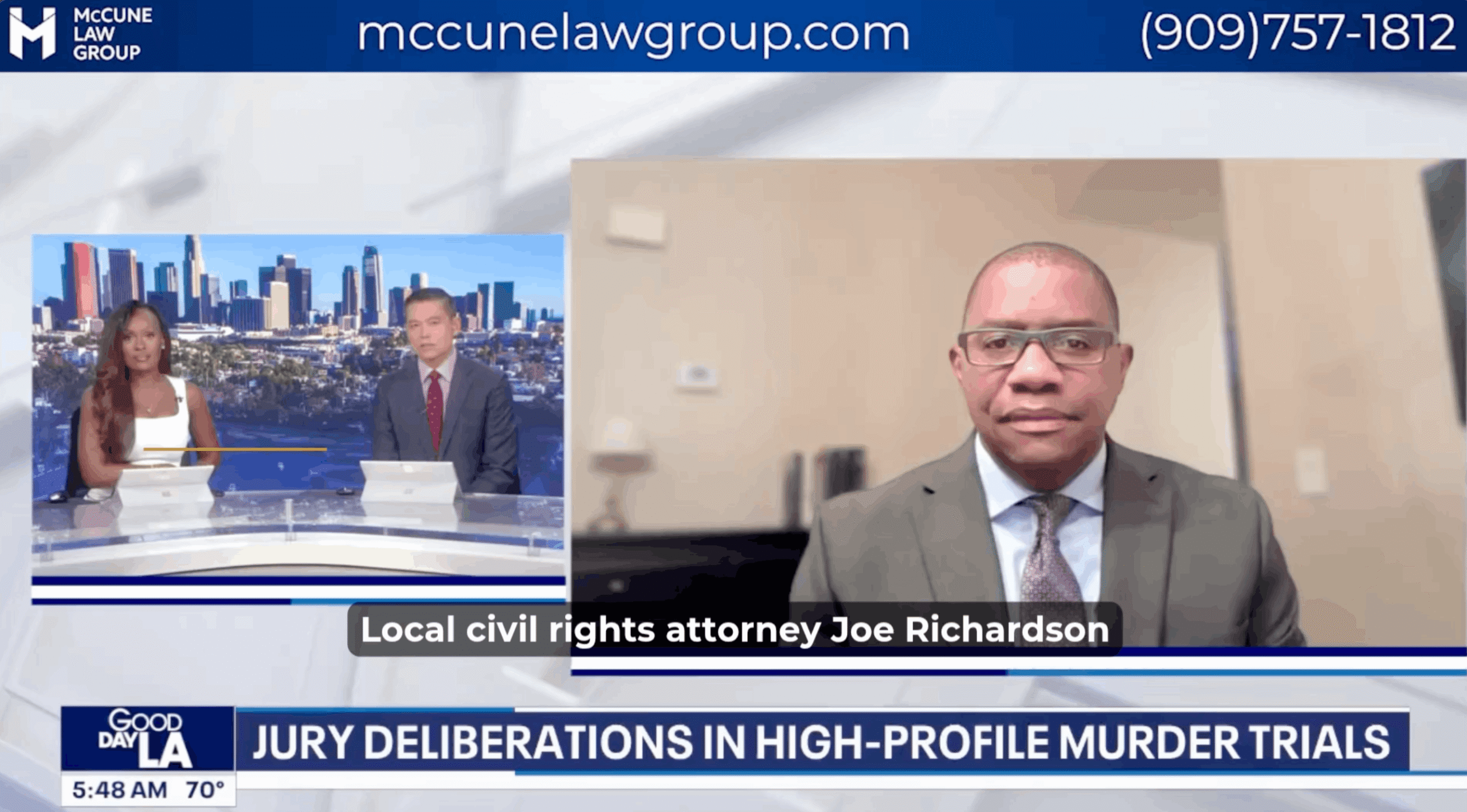
McCune Law Group Attorney Joe Richardson Discusses Tupac Shakur and Lindsay Clancy Trials on Good Day LA
MLG civil rights attorney Joe Richardson joined FOX 11’s Good Day LA last week to offer legal analysis on two closely watched murder trials nearing their conclusion: the Las Vegas trial of Duane “Keffe D” Davis in the 1996 killing of Tupac Shakur, and the Massachusetts trial of Lindsay Clancy. Richardson has previously appeared on CNN’s Laura Coates Live and Law&Crime Network’s Sidebar podcast as an expert legal analyst.
On the Davis trial, Joe explained why the case against Davis came down almost entirely to his own words. At the same time, Joe noted that relying on Davis’ prior statements was a major weakness: with no physical evidence and nothing placing him at the scene, prosecutors needed jurors to believe those statements were true, even as Davis’s own defense team argued he’d exaggerated his role to get a better deal on an unrelated drug case. The usual dynamic – where a defendant’s own lawyers are the ones vouching for him – was flipped.
Turning to the Clancy trial, Joe pointed out another detail most people get backwards: it wasn’t up to Clancy’s defense to prove she was experiencing psychosis. Prosecutors had to prove she wasn’t. He also walked through the dueling experts at trial and how juries typically start deliberating, usually by taking an early, informal poll just to see where everyone stands before digging into the evidence.
Joe returned to Good Day LA the next morning after a Las Vegas jury convicted Davis of first-degree murder in Shakur’s killing, reaching a verdict in less than three hours.
Video Transcript
[0:00] ANCHOR 1: Welcome back. You’re watching Good Day LA. If you’re listening to us on 790 KABC, thanks for joining us this morning. Have a safe morning drive. Jury deliberations are scheduled this week in two high-profile murder trials, Lindsay Clancy and Tupac Shakur. These are cases we’ve been watching for weeks now. And joining us live to talk more about them is local civil rights attorney Joe Richardson. Joe, thanks for joining us this morning.
[0:25] JOE RICHARDSON: Morning. Good to see you.
[0:25] ANCHOR 1: Good morning. So you’ve been following these cases very closely. Let’s start with what’s happening in Las Vegas with the Tupac Shakur murder trial. What can we expect to hear today in closing arguments?
[0:38] JOE RICHARDSON: Well, each side is going to talk about the things that brought them to the table, as it were, the things that they think make them strong. On the prosecution side, they’re gonna talk about Keffe D’s words, Keffe D’s words. He said it here, he said it in the proffer, he said it as part of his book, he said it on Vlad TV. And so therefore, it’s in enough detail and consistent enough where we can believe it, and that he was the shot caller, handed his nephew the gun, who then killed Tupac, making him criminally responsible, and the surrounding evidence goes with it. The defense is gonna say, “No, actually he said this, but he said it in order to create leverage for the proffer and to get money, and because other people were saying things, and you shouldn’t believe him because you’re missing other things, like the gun and somebody putting him at the scene.” There’s no evidence putting him at the scene. And even though he’s a shot caller, there’s no evidence that he called the shot. So each side is going to seek to show the jury that they delivered on the promises they made in their opening statement.
[1:38] ANCHOR 2: You know, it’s interesting, Joe, because there is this argument on why he did it, what’s the motivation, if it’s proof that he killed or played a part in killing Tupac, or if he was just trying to get attention. But what’s not really arguable is that the prosecution likely would not have had really anything to charge him with had it not been for his own interviews and media appearances and desire to go on television saying that he was involved in this.
[2:07] JOE RICHARDSON: Oh, yeah. That’s all they had, and I think that’s bad news for the prosecution, because frankly, if the case was as strong—
[2:13] ANCHOR 2: Mm-hmm.
[2:13] JOE RICHARDSON: …as the defense will suggest, if it was as strong as they stated, they could have brought this a long time ago. And therefore, the jury might be cognizant of that, like, ‘Hmm, why wasn’t this brought before?’
[2:25] ANCHOR 2: Mm-hmm.
[2:25] JOE RICHARDSON: Sometimes the passage of time can make a case stronger if you’re talking about DNA, but you don’t have anything like that in this case. So yeah, that is a bit of a problem for the prosecution, and they’re gonna have to explain it really well. And ironically, they need the defendant to be believed. The prosecution needs the defendant to be believed, and the defense, who normally wants the defendant to be believed, at least by the surrounding evidence, wants to say he’s a liar. So it’s a little bit, you know, the hat’s on the other head there.
[2:54] ANCHOR 1: Not only that, Joe, but over the past 30 years, Davis has sort of contradicted himself. He’s told one story, and then, [laughs] something else. So what he said even in the book is contradicted by some other statements he’s made in the past.
[3:09] JOE RICHARDSON: Yeah. I mean, there can be, depending on what spot or situation you found Keffe D in, where he was, what he was talking about, you know, there’s offline things, there’s a couple taped things, et cetera. It’s not clear that it’s as consistent as it ought to be. And fundamentally, is this somebody who should be believed at all? He made this proffer to keep from going to jail for a long time under the drug case that they brought against him. So he was motivated to not tell the truth, help them close the book on Tupac, and move on. But again, if the case was so strong all that time ago based on what he told them, they should have been able to find surrounding evidence, and that surrounding evidence is just not there.
[3:54] ANCHOR 2: Let’s talk about Lindsay Clancy now, because here we are with another high-profile case out of Massachusetts that the entire country is watching. This case hinges on the postpartum psychosis defense. And if I’m clear on Massachusetts law, it’s not really up to her lawyers to prove that she was hallucinating, rather the prosecution has to prove that she was not hallucinating, right?
[4:18] JOE RICHARDSON: Yeah, that’s absolutely right. You have to prove that she did the deed, as it were, but you also have to prove that at the time she did it, she had the ability to conform her conduct to the law. So this is something where the defense can kind of sit there with their arms folded, because the prosecution actually has the burden of proof, including, to your point, proving beyond a reasonable doubt that she could not conform her conduct to the law, in other words, that she should be criminally liable. And that might be a tall order.
[4:53] ANCHOR 1: This is just a terrible situation, and it’s a case that really has gripped the entire country. We’ve heard during this trial from different experts trying to get into the mind of Lindsay Clancy, trying to figure out what she was thinking and dealing with at the time. And yet we heard two different experts contradict each other on whether or not she had this psychosis and was dealing with it at the time she killed her children.
[5:23] JOE RICHARDSON: Yeah, I mean, basically one is saying that the world is flat and the other one is saying that the world is round. You had her psychiatrist not find psychosis the day before she did what she did, and then you have people seeing her on behalf of the government weeks to months, as opposed to years, before this trial. And there’s a question as to how credible they would be because they didn’t see her in real time when it happened. So this is a case that is a battle of the experts.
[5:52] ANCHOR 2: Mm-hmm.
[5:52] JOE RICHARDSON: They’re going to go back and forth, and it’s going to be very big, who the experts, which of the experts, is actually believed. And I think that in this way, the defense, during their closing argument, punched some holes in the prosecution’s experts pretty well, and it’s given the jury something to think about.
[6:10] ANCHOR 2: Let’s talk about both juries in these kinds of high-profile cases, because the jurors already have the case in Massachusetts with Lindsay Clancy, and they’re set to get the case with Keffe D pretty soon, within the first few hours, I guess, in the Tupac trial, going on ongoing with Lindsay Clancy. What goes on in those rooms when the jury starts deliberating?
[6:33] JOE RICHARDSON: Well, often what you’ll hear is that at some point there is some measuring stick where there’s a discussion, ‘Hey, where is everyone?’
[6:41] ANCHOR 2: Okay.
[6:41] JOE RICHARDSON: So that we know where we’re starting, as it were. Now, there’s no hard and fast rule about that, but in Clancy, you’ve got a lot of evidence to go through. You’ve got 85 witnesses, you’ve got 200 pieces of evidence. And in Clancy particularly, there were 18 jurors, and you didn’t know until the end which ones were actually going to go into the jury room. So everybody’s taking notes, everybody’s paying attention. So even as they go over the evidence, they’re going to go in with some ideas based on everything they’ve seen. There’ll be a measuring stick in terms of where everyone is, and each side could probably find evidence that supports whatever it is they’re thinking and leaning toward. But hopefully they’re being thorough, so that they come out to something that’s good based on what it is they’ve seen in the evidence.
[7:28] ANCHOR 1: We’ll be watching both cases very closely as we get to this Monday. Joe Richardson, thanks for joining us—
[7:36] ANCHOR 2: Yeah, we appreciate it—
[7:36] ANCHOR 1: …this early in the morning. We appreciate it.
[7:39] JOE RICHARDSON: Thank you, guys. Have a good day.
Video Transcript
[0:00] ANCHOR 1: Sentencing is set for October in the murder of Tupac Shakur.
[0:04] ANCHOR 2: Yeah, 30 years later, a Las Vegas jury has found 63-year-old Duane “Keffe D” Davis guilty of first-degree murder in the 1996 killing of the rap star.
[0:14] COURT CLERK: The verdict reads as follows: ‘We, the jury in the above entitled case, find the defendant, Duane Keith Davis, as follows: count one, murder with use of a deadly weapon, guilty of first-degree murder with use of a deadly weapon, dated this 31st day of August 2026.’ Ladies and gentlemen of the jury, is this your verdict as read? So say you one, so say you all.
[0:33] JUROR: Yes.
[0:33] JUROR: Yes.
[0:35] JUROR: Yes.
[0:35] ANCHOR 2: Jurors reached the verdict in less than three hours. Prosecutors said Davis orchestrated the drive-by shooting and provided the gun, but did not pull the trigger. Joining us again this morning is local civil rights attorney Joe Richardson. Joe, it was only 24 hours ago that we talked to you about this case. I’m curious if you’re surprised at how quickly the jury came to a verdict here.
[0:56] JOE RICHARDSON: Yeah, I am a little bit surprised at the speed. But you see this long enough and sometimes they come in very, very quickly. This lets you know this is no Lindsay Clancy case. But at the end of the day, the jury really believed that Keffe D was in the place. The through line here, I believe, was him being in the car. The prosecution acknowledged he tinkered around the edges over the years, embellished some details a little bit differently. But the through line, what he was consistent about, had him in the car. We know he was shot from in the car, and therefore, the jury was able to land, and they landed pretty quickly, which is a little bit of a surprise, but they landed nonetheless.
[1:38] ANCHOR 1: I don’t think you’re the only one that’s surprised.
[1:40] ANCHOR 2: Mm-hmm.
[1:40] ANCHOR 1: We’re talking about a case that is 30 years old. It took prosecutors this long to bring this case to trial. There was no physical evidence in this at all, even a lack of some witness testimony as well. What do you think led to this conviction?
[2:02] JOE RICHARDSON: Well, there’s a couple things. First of all, to your point, there was not a whole lot of physical evidence, and there can be admissions in a trial that are used against a defendant, but usually there’s a lot of information that corroborates it and surrounds it. You didn’t have a lot of that here, but what you did have a lot of, you had a lot of admissions over and over again. And what I think may have happened here, we’ll see if we hear from the jury, is that the jury probably didn’t want their intelligence to be insulted. There was a couple things powerful that the prosecution said at the end. One was, ‘He bragged about beating the feds. Now he’s trying to beat you.’ The other thing he said is, ‘Do you think this guy is dumb enough to write a book, but smart enough to keep a lie for years and years?’ And at the end of the day, maybe their story passed the common sense test better.
[2:55] ANCHOR 1: Mm-hmm.
[2:55] JOE RICHARDSON: The defense was like, ‘This didn’t happen, this didn’t happen, this didn’t happen.’ They talked about things leading up to Vegas not happening. And after a while, maybe the jury might have been thinking, this guy is a shot caller and on some level, if not anywhere else on the street, his word is important. So why shouldn’t we believe him here? If he believes it enough to say it, then why shouldn’t we?
[3:18] ANCHOR 1: Mm-hmm.
[3:18] ANCHOR 2: Joe, I’m sure we’re gonna see almost immediate appeals. Do you see any grounds for even an attempt?
[3:25] JOE RICHARDSON: Not immediately. However, you know, the defense, that’s their job.
[3:30] ANCHOR 2: Mm-hmm.
[3:30] JOE RICHARDSON: And whether we’re talking about the speed, what they came back with, what the jury may say publicly about what was thought of, et cetera. Also, some of the evidentiary decisions, some of the things that got in that hopefully the defendant didn’t want to get in, hoped would not get in. There’s gonna be a lot to peer through, but the speed arouses some concerns in and of itself. Is there a way that maybe they didn’t consider a whole lot of the evidence? But the same thing that can make you laugh will make you cry, the defense did not put up much of a defense at all. They just had three witnesses. They were pretty confident, and of course, they didn’t put Keffe D on the stand. They were pretty confident about how this thing is gonna come out. So the speed in and of itself is not gonna do it, but they’ll peer through the evidence, especially as it pertains to some of the things that were admitted, what they find out about what the jury said and see if that takes them somewhere.
[4:18] ANCHOR 1: Well, now that the jury has spoken, you’ve been at this for a long time. Is this not like a cautionary tale for someone out there, putting a book out there-
[4:27] ANCHOR 2: Mm-hmm.
[4:27] ANCHOR 1: …admitting this stuff, that you did this, whether you did it or not, but just to put it out there. You could write anything and yet that could incriminate you, and send you to prison for the rest of your life.
[4:41] JOE RICHARDSON: Yeah, I mean, it gets kind of deep, but it shouldn’t be. At the end of the day, if he’d kept his mouth shut-
[4:47] ANCHOR 2: Mm-hmm.
[4:47] JOE RICHARDSON: …he wouldn’t have this problem. And the other thing I would say is, he went out of his way to correct things to make sure they were accurate as it pertains to the proffer so that he knew he wouldn’t go to jail for a long time for the drug charge. So yeah, it is a matter of being quiet when you know that you have an opportunity not to go to jail. He looked at, saw what was going on out there and he decided to say something, and it was a mistake, and he said it over and over again.
[5:14] ANCHOR 2: It’s so interesting because at the same time, there’s this long conversation that’s been happening about rappers and about prosecutors bringing charges against rappers for things they say in songs. That’s completely different, it seems, from willingly, voluntarily going on an internet blog on video saying, ‘I committed a crime. This is how I did it. This is why I did it,’ and doing it repeatedly.
[5:44] ANCHOR 2: This is just wild to me, this whole thing has been.
[5:48] JOE RICHARDSON: Right. I was gonna mention that, when you think of Young Thug and some other cases-
[5:51] ANCHOR 2: Mm-hmm.
[5:52] JOE RICHARDSON: …where there’s some First Amendment concerns, and something, is it life imitating art? But to your point, Keffe D went out of his way. He was not Tupac. He was not a rapper. He was not on a record talking about this stuff in extensive detail time and time again. And ultimately, he kind of did it to himself. We can’t argue First Amendment. We can’t argue context because there’s a rap record. There’s nothing. There’s just him and what he said, and the jury stuck him for it.
[6:20] ANCHOR 1: That’s right.
[6:21] ANCHOR 2: Yeah, it’s… I was talking to a colleague this morning about how in the future, people are gonna study our culture’s obsession with clout, internet fame, and going viral. I don’t know, Joe, we could talk to you all morning. Thank you so much-
[6:32] ANCHOR 1: [laughs] Thank you
[6:32] ANCHOR 2: …for being here.
[6:33] JOE RICHARDSON: Thanks for having us. Appreciate it.
[6:34] ANCHOR 1: We appreciate you, Joe. Thank you.
Update:
Days later, the Clancy trial ended in a mistrial after Massachusetts’s highest court rejected a last-minute defense appeal to have a holdout juror removed. NBC News has more on the mistrial. Prosecutors are now deciding whether to retry the case. Richardson said afterward that continued public attention on the case is a good thing, since transparency matters, but that it shouldn’t obscure the tragedy at its center.
About Joe Richardson
At McCune Law Group, Richardson leads the firm’s Racial & Economic Justice Practice, litigating employment, civil rights, and class action cases involving the treatment of disadvantaged individuals, alongside advocacy work with community, business, and religious leaders across the Inland Empire. Learn more about MLG’s Civil Rights practice.
Joe Richardson is not affiliated with any party in the Duane “Keffe D” Davis or Lindsay Clancy matters and has no role in either case. His appearances reflect his ongoing work as a national and local legal commentator, including regular appearances on Good Day LA, CNN, Court TV, and Law&Crime Network.
Attorney Advertising.
McCune Law Group, APC is responsible for this content. Counsel Joseph Richardson is licensed to practice in the state of California and Washington, D.C. Principal Office: Ontario, California.